

Online Music Therapy with Liam
- Clara Browning

- Jun 1, 2020
- 7 min read
Updated: Jun 8, 2020
I did not think it would be plausible for music therapy to continue during lockdown. As with many other professions, I thought it would be put on hold for the foreseeable future. I was very aware of my clients both at school and in dementia care homes who were attending therapy and would be left in the lurch, most likely unable to understand the need for contact to suddenly stop. In terms of my work at school (which is the focus of this blog), its sudden closure together with my own need to self-isolate a week before it closed, meant that it was not possible to prepare children and young people for this temporary halt in therapy.
It quickly became clear that lockdown would be a long process in which children and families would be confined to their homes with no face-to-face support. This was perhaps the time when our children and young people needed therapeutic input most of all. With encouragement from our headteacher, I began to offer some online music therapy sessions via Zoom. I was unsure of how these would work, or even whether they would work. Music therapy is very much about being together, making music together, building a therapeutic relationship, the therapist following or supporting the child’s music and play… all of which require being physically together in each other’s presence. Many music therapists were starting to work online and an organisation called Chiltern Music Therapy quickly put together an excellent training on ‘digital music therapy’ (https://www.chilternmusictherapy.co.uk/training/therapists), which helped me to navigate setting up Zoom for therapy purposes and gave some practical ideas for how music therapists can continue their work in an online capacity.
The children I had been working with in school have a range of diagnoses, including Down syndrome, autism spectrum disorder, and profound and multiple learning disabilities. It was difficult to know how they would respond to online sessions. However, those I have been able to work with online continuously surprise me with how they engage with musical and verbal interaction via a screen. As my music therapy supervisor has pointed out, technology is in fact a much more familiar medium for many children and young people, including those with special needs.
Liam (not his real name) is 12 years old. He has autistic spectrum disorder (ASD), is non-verbal and can become distressed and unsettled when routines are changed. I started working with Liam in individual music therapy in September 2019 and he has attended music therapy with other therapists in previous years. Since September, we have worked together on a weekly basis using music to address psychological and developmental aims, such as providing opportunities for self-expression and supporting social interaction skills. Liam was always happy to come to music therapy with me at school, linking my arm when I collected him from class and leading the way to the music room. He enjoyed exploring the instruments, creating and sticking to certain routines of what we would play first and next, and particular ways we would play each instrument. I would instigate something new every now and again – a new song or a new instrument, which Liam would accept and enjoy with a little encouragement, as he usually liked to have control of every detail of what we did together in music therapy. This was one of the social skills we were working on – sharing control. Liam particularly enjoyed exploring instruments with his ear touching their surface, feeling the vibrations and listening to the sound close up.

Liam holding the ukulele to his ear during one of our online sessions, as he regularly did in our music therapy sessions at school.
As for many of the children at our school, the abruptness of lockdown in March must have evoked high levels of anxiety for Liam and his family. While Liam understands speech relatively well, it would have been challenging to explain the social and emotional implications of COVID-19, the need to stay at home and why we are no longer following normal routines such as going to school. When Liam’s family and I decided to try online music therapy sessions, I emailed Mum a photo of myself within a computer screen so that she could try to explain to Liam that he would see me on the screen ahead of time, and that we would therefore have a music therapy session together. Visual cues are often used for children with autism as these can support communication, language development and ability to process information.
In Liam’s first online music therapy session, I was pleasantly surprised at how well he was able to engage with me and the music in this very different way: on screen rather than in person. He looked excited and also a little confused to see me, but he was very attentive throughout the session. Mum and sister Annabelle (not her real name) were present and have been in all online sessions.

Whereas normally in a school context it is not possible to have family members present in music therapy, the unique circumstances we find ourselves in in the midst of lockdown have brought a different dynamic to Liam’s therapy: he now experiences music therapy with family each week, and it is very clear that he enjoys sharing this with Mum and Annabelle. It has also been a wonderful insight for me into family relationships, and has given me a depth of knowing Liam that I would not otherwise have had the privilege of gaining as a music therapist working in a school context. Here is a clip of Liam and his sister enjoying the song Sleeping Bunnies together:
Another major and unexpected positive that has come from these online sessions is Liam’s ability to engage for longer periods of time than during face-to-face music therapy, rather than shorter as I had anticipated. In music therapy at school, Liam used to follow a very particular routine each week of going from our ‘Hello’ song to the piano, then the drumkit and perhaps choosing one or two other instruments before pointing to the guitar, which we use for the ‘Goodbye’ song, to show me that he was ready to leave. His sessions lasted approximately 20-25minutes. In our online sessions, however, Liam sits in front of the computer fully attentive for half an hour without showing any sign that he wants to end the session. This has been consistent throughout our online sessions. He may be more attentive for various reasons, such as enjoying interactions with his mother and sister, and being in the comfort of his own familiar space.
I have also been reflecting on the fact that Liam may experience interacting through a screen to be far less intense than face-to-face interaction. It is known that people with ASD see, hear and feel the world differently to other people; interacting with others can be difficult and eye contact is often avoided. I once heard an autistic young man describe eye contact as intense and frightening, as if ‘someone is looking into my soul’. This may seem like an extreme description but is a likely reality for many people with ASD. Perhaps the slight detachment of digital interaction, the very element that I find frustrating as the therapist, is more tolerable and comfortable for someone like Liam, enabling him to engage and participate to a greater extent. While I expected Liam to put his ear up close to the computer for the duration of our online music therapy sessions, as he does when exploring sound, instead he looks at me on the screen for substantial periods of time, which he rarely does in face-to-face sessions. Of course, looking ‘at each other’ online is not the same as direct eye contact: we look at each other’s image on the screen, rather than directly at each other’s eyes. I am wondering whether this subtle difference opens up the opportunity for Liam to engage in intentional social interaction for longer and in a way that is more comfortable for him.
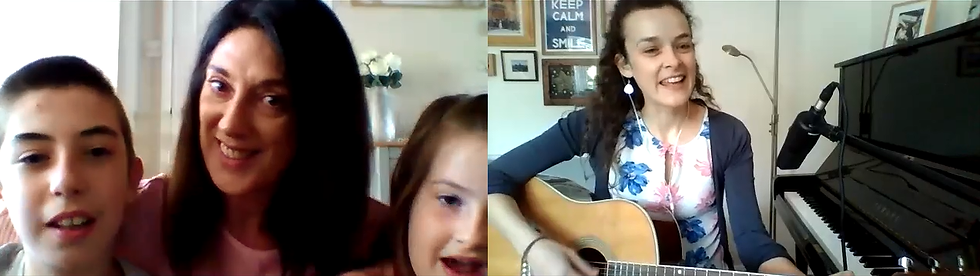
Looking ‘at’ each other on Zoom is less direct than face-to-face eye contact and may have helped Liam to engage with music therapy for longer periods at a time.
As well as enabling continuity of Liam’s music therapy, online sessions have also simply provided fun and a positive experience for Liam and the family, according to his mum. She wrote,
Having a weekly music therapy session online has been a hugely positive experience.
It has become the highlight of Liam’s week; he gets very excited and walks around with the laptop anticipating his session to start each week.
By being able to join in from his own home whilst calmly sitting beside his sister, he has had the opportunity to join in and physically interact with another child, something he can find very difficult to do in other environments.
It has been wonderful to see him so happy and engaged through music allowing him to switch off his anxieties and be so focused and involved, making choices and having the opportunity to express himself through music and the relaxed way an online video session allows.
Here is a final clip of our ‘Hello’ song followed by If You’re Happy and You Know It. In order to protect the real names of the children, we join the clip singing ‘hello’ to Mum and then to me. At the start of the session a few minutes previously, it had been clear that Liam and Annabelle were both very happy in mood, and so I had said, ‘Everyone’s happy this morning!’ … This was why we then launched into the song If You’re Happy and You Know It immediately after the ‘Hello’ song.
If You're Happy and You Know It, reflecting the positive moods of Liam and Annabelle during this online music therapy session. There is a slight delay in the recording between my singing and Liam's family's singing due to the limitations of online working.
Working online with Liam has given me plenty of food for thought about how music therapy has necessarily adapted during this time and how the unexpected positives, such as increased engagement online and the benefits of family work, could somehow be incorporated to music therapy work in schools beyond lockdown.
Many thanks to Liam and his family for kindly allowing me to share our work together. Thank you also for reading this far; please do pass on to anyone you feel might be interested, thank you.

Wonderful to see your calm, focused and musical approach, Clara, and to see the results.Very moving and inspiring